RESOURCES
ATS Guides
Understand ATS and optimize with confidence.
Practical guides, examples and strategies to help you understand how applicant tracking systems read resumes, improve alignment, and make your strongest truthful experience easier to recognize.
THE BASICS
What is an ATS and why does it matter?
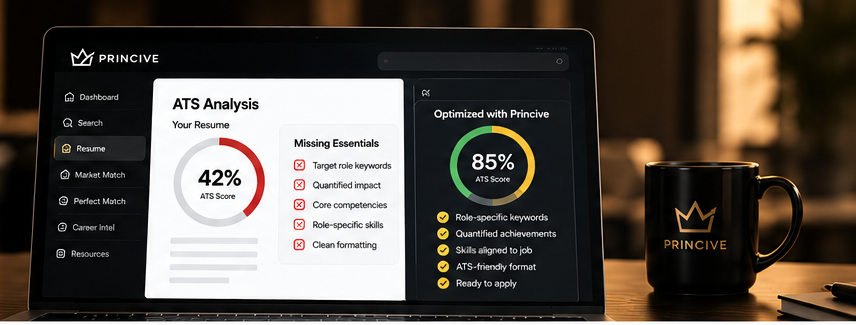
An Applicant Tracking System helps employers collect, organize and review applications. Some systems also support parsing, search, filtering or ranking. Understanding how these systems handle resume information can help you present your experience more clearly.
Parses
Reads structured resume information such as titles, dates, skills and experience.
Organizes
Stores applicant information so recruiting teams can review and manage candidates.
Filters
Can help teams narrow candidate pools based on structured criteria or searches.
Surfaces
Helps recruiting teams find applications that appear relevant to a role or search.
Supports Review
Recruiters and hiring teams still evaluate the actual experience, evidence and fit.
HOW TO IMPROVE
From weak alignment to a stronger application.
Improving ATS alignment is not about stuffing keywords. It is about making relevant skills, accomplishments, role language and measurable impact easier to recognize while keeping the underlying experience true.
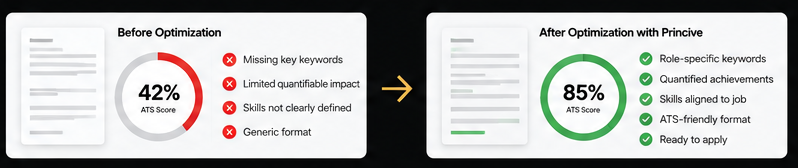
Clear role language, relevant skills, quantified outcomes and readable structure matter more than gimmicks.
GUIDE CATEGORIES
Explore ATS guides and strategies.
Learn the fundamentals, understand what optimization actually means, and see how keywords, skills, formatting and evidence work together.
ATS Fundamentals
How ATS works, what it does, what it does not do, and where myths begin.
Guides coming soon →ATS Optimization
Practical ways to improve alignment while preserving the truth of your experience.
Guides coming soon →Keywords & Skills
How to identify relevant language from a role and connect it to real evidence.
Guides coming soon →Formatting
Readable resume structure, headings, dates, layouts and file choices.
Guides coming soon →Real Examples
Before-and-after examples showing how clearer evidence changes the application.
Guides coming soon →POPULAR ATS GUIDES
Start with the questions people ask most.
These are the first editorial guides planned for this hub. We will convert each card into a live internal link as the article is published.
What Is an ATS? A Complete Guide
Understand what applicant tracking systems do and how they fit into modern recruiting.
Coming soon →How ATS Resume Optimization Actually Works
Separate practical optimization from keyword stuffing, myths and outdated tactics.
Coming soon →How to Find Resume Keywords for Your Target Role
Use the language of the role to surface the strongest relevant evidence from your experience.
Coming soon →ATS-Friendly Resume Formatting
Build a resume that is easy to parse and easy for a recruiter to read.
Coming soon →ATS Before and After: Real Resume Examples
See how clearer role language, evidence and structure can improve alignment.
Coming soon →THE PRINCIVE VIEW
ATS optimization is not the goal. Better signal is.
A resume can be technically readable and still do a poor job of communicating why someone fits a role. ATS optimization should support stronger representation of real experience, not replace it.
That is why Princive looks at alignment, evidence, role language and market context together rather than treating ATS as a standalone score.
Explore Career Intelligence →FROM UNDERSTANDING TO ACTION
See the gaps. Improve the representation.
Start with Fit Check to understand alignment. Use Market Match to strengthen your market-level positioning, then Perfect Match for a specific opportunity.
Fit Check
See your baseline ATS alignment and the essentials your resume currently covers.
Run Fit Check → $99 ONE TIMEMarket Match
Build a stronger reusable resume for the target market or role family you want.
Explore Market Match → $49 PER OPPORTUNITYPerfect Match
Optimize the strongest truthful version of your experience for one exact role.
Explore Perfect Match →ATS FAQ
Questions people ask about ATS.
What is an applicant tracking system?
An applicant tracking system, or ATS, is software employers use to collect, organize and manage job applications. Depending on the system and employer setup, it may also support resume parsing, search, filtering, ranking or workflow automation.
Do ATS systems automatically reject resumes?
Some employer workflows can apply screening rules or filters, but ATS behavior varies by system and configuration. It is more accurate to think of ATS as recruiting infrastructure rather than one universal algorithm that treats every resume the same way.
What makes a resume ATS-friendly?
An ATS-friendly resume uses clear structure, recognizable headings, readable formatting and accurate role information so important experience can be parsed reliably. Relevance and evidence still matter once the application reaches a person.
Should I use keywords from the job description?
Relevant role language can help clarify alignment when it truthfully reflects your experience. The goal is not to copy keywords blindly, but to connect the language of the role to evidence you genuinely have.
Is a higher ATS score always better?
A score can be useful as a diagnostic signal, but it should not be treated as a guarantee of interviews or hiring outcomes. Strong applications also depend on role fit, evidence, market context and how clearly the resume communicates value.
How does Princive Fit Check work?
Fit Check evaluates the alignment between a resume and a target role and surfaces a baseline ATS score plus the essentials currently covered. It is designed as a starting diagnostic before deeper optimization.
SEE WHAT ATS SEES
Start with your current resume.
Run a free Fit Check to understand your baseline alignment before you decide what needs to change.