Resume Guides
RESUME FUNDAMENTALS
The building blocks of a stronger resume.
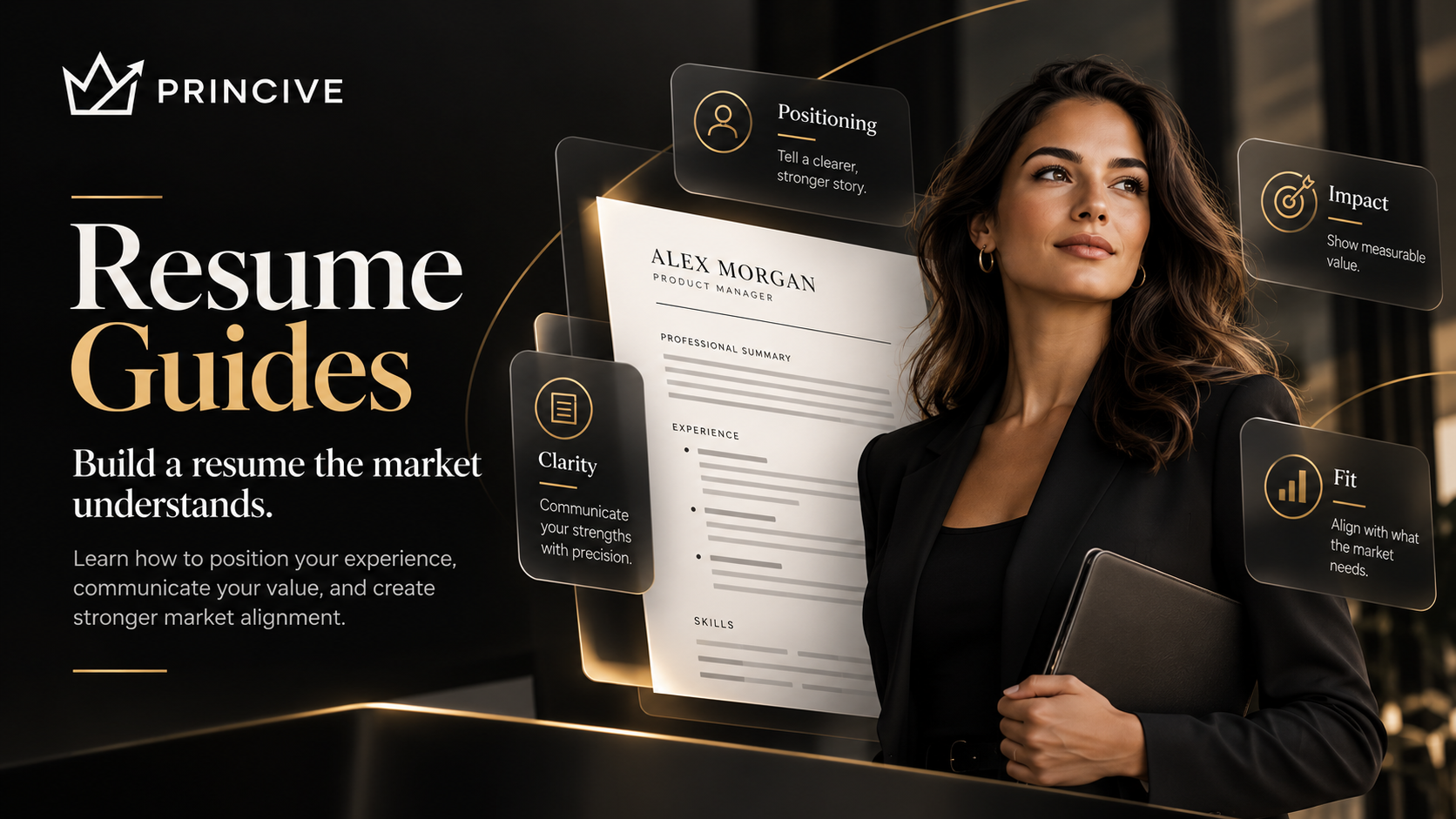
A strong resume makes your value easy to understand. These five signals help both people and hiring systems interpret your experience.
Clarity
Make your experience and value easy to understand in seconds.
Relevance
Bring forward the experience that matters most for the target.
Evidence
Use real accomplishments and results to prove what you can do.
Impact
Show measurable outcomes and the business value you created.
Seniority
Make scope, leadership, progression and complexity visible.
TWO WAYS TO OPTIMIZE
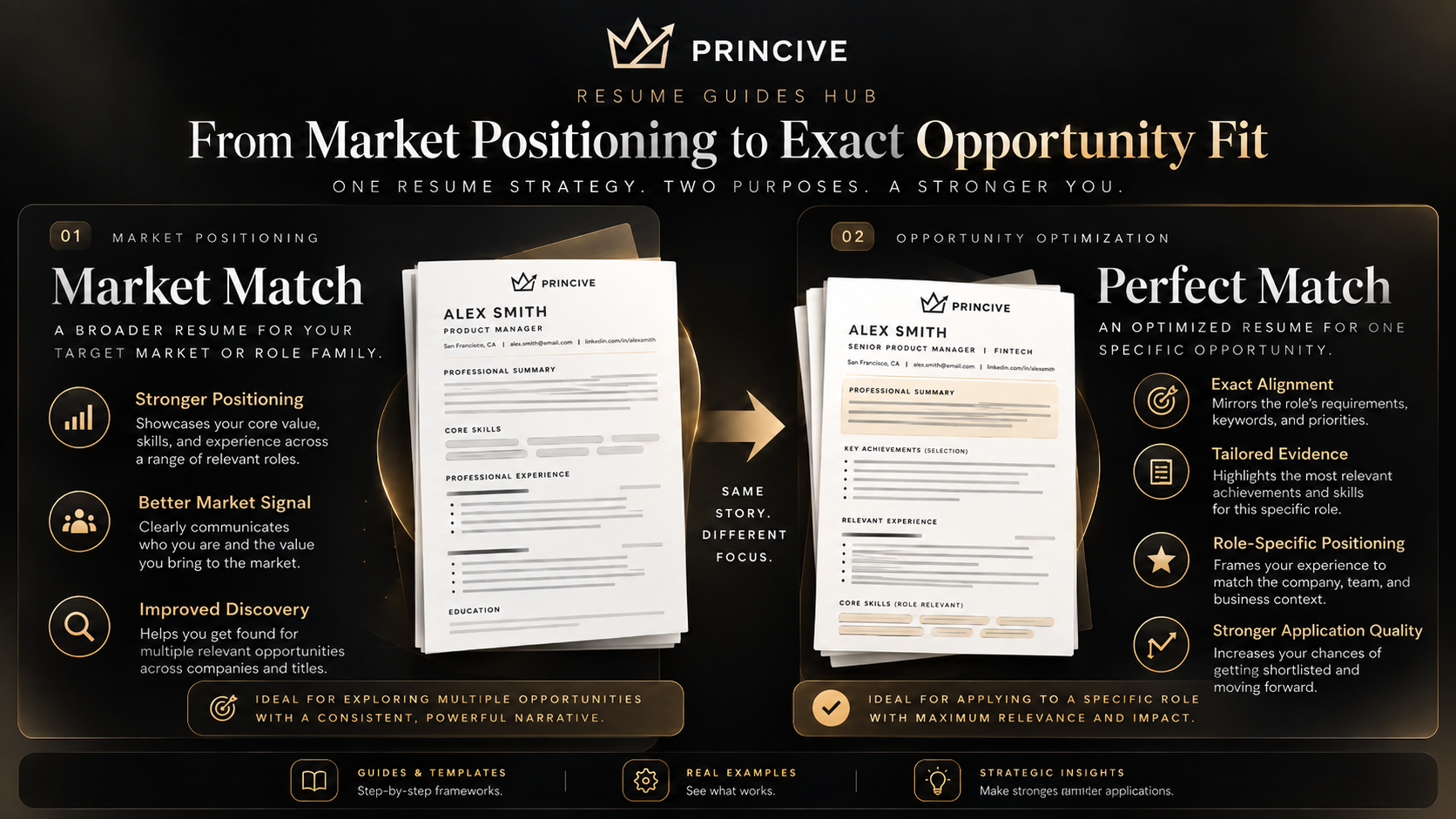
Market positioning vs. exact opportunity fit.
The same experience can require different emphasis depending on whether you are targeting a market or applying to one exact role.
EXPLORE BY TOPIC
Guides for every stage of your resume journey.
Start with the problem you are trying to solve, from fundamentals and ATS readability to senior-level positioning and job-specific tailoring.
Resume Fundamentals
Structure, summaries, bullets, impact, length and core best practices.
Guides coming soon →ATS Guides
Parsing, keywords, formatting and what applicant tracking systems actually do.
Guides coming soon →Tailoring Guides
How to change focus and emphasis for a specific role without inventing facts.
Guides coming soon →Role-Specific Guides
Resume strategy for product, growth, strategy, operations and other role families.
Guides coming soon →Executive & Senior Guides
Leadership, scope, strategic impact, influence and seniority at higher levels.
Guides coming soon →SEE YOUR RESUME SIGNALS
Understand what the market can see in your experience.
Strong positioning starts with understanding the signals already inside your career: fit, evidence, trajectory, leadership and market alignment.
Explore Career Intelligence →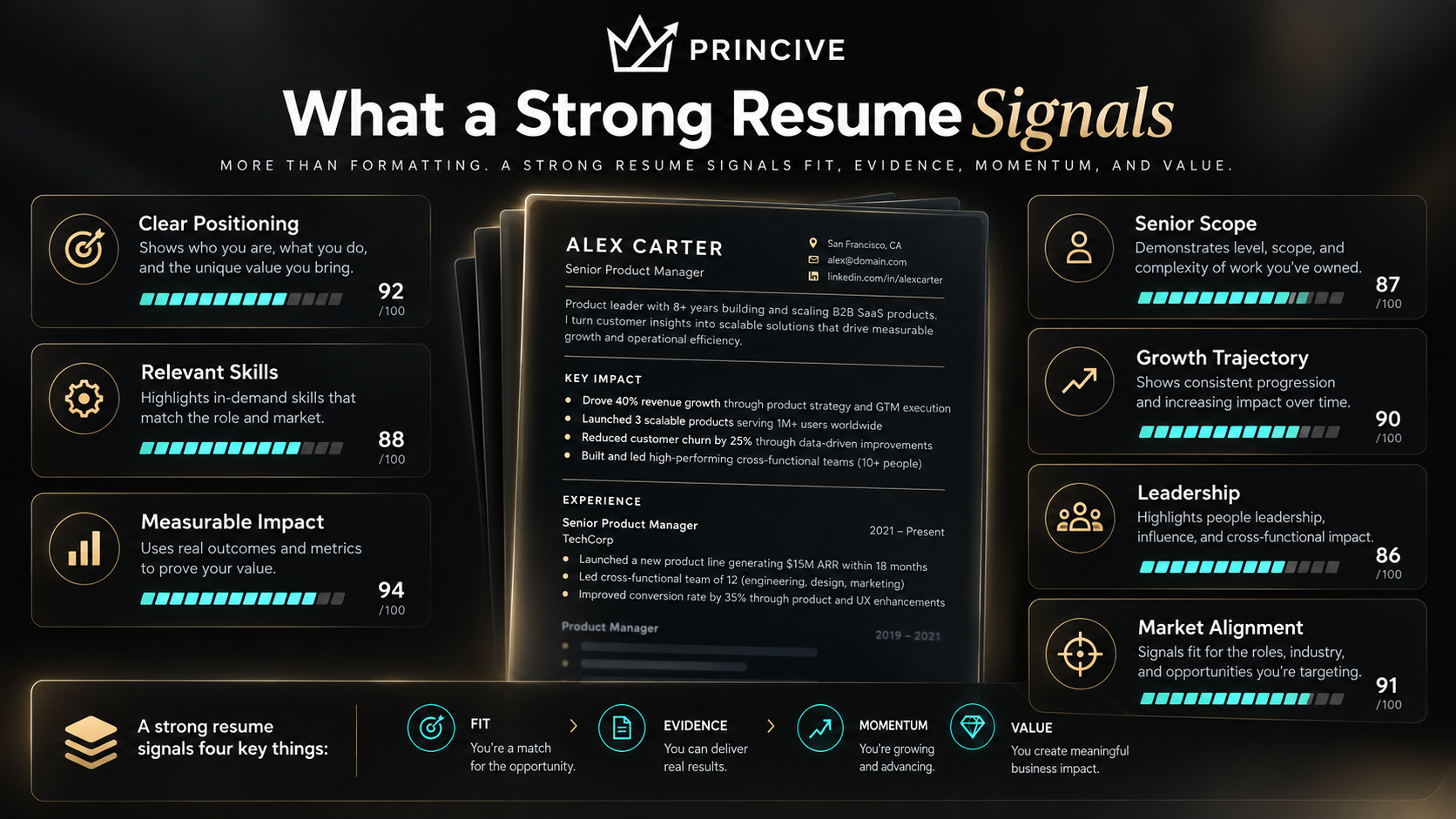
POPULAR RESUME GUIDES
Start with the questions people ask most.
These are the first editorial guides we will publish under the hub. Until they are live, the cards remain intentionally text-first.
How to Write a Resume That Gets Interviews
Build a clear story around relevance, evidence and measurable impact.
Coming soon →ATS Resume Tips: What Actually Works
Separate useful ATS practices from outdated resume myths.
Coming soon →How to Tailor Your Resume for a Specific Role
Choose what to emphasize without rewriting your entire career.
Coming soon →Senior Product Manager Resume Guide
Show product scope, leadership, strategic impact and seniority clearly.
Coming soon →Common Resume Mistakes — And How to Fix Them
Remove the patterns that make strong experience harder to understand.
Coming soon →THE PRINCIVE VIEW
One resume should not have to solve every problem.
A market-level resume and a job-specific resume have different jobs. One should represent you clearly across a coherent market. The other should surface the most relevant truthful evidence for one exact opportunity.
The facts stay true. What changes is focus, ordering and emphasis.
RESUME FAQ
Questions behind a stronger resume.
What makes a strong resume?
A strong resume clearly communicates who you are, what you have accomplished, the level and scope at which you have operated, and why your experience is relevant to the market or opportunity you are targeting.
What does ATS-friendly mean?
ATS-friendly means the resume is structured so important information such as titles, employers, dates, skills and experience can be parsed reliably while still reading clearly for a person.
Should I tailor my resume for every job?
Not every role requires a complete rewrite. A strong market-level resume can cover a coherent role family, while high-value opportunities may justify deeper job-specific optimization.
What is the difference between Market Match and Perfect Match?
Market Match creates a reusable target-market version of your resume. Perfect Match optimizes that representation for one exact opportunity.
Can AI improve a resume without inventing experience?
Yes. AI can clarify, organize, prioritize and strengthen the presentation of real experience while keeping candidate facts and accomplishments as the source of truth.
BUILD THE RIGHT RESUME FOR THE JOB IT NEEDS TO DO
Stronger positioning.
Stronger opportunities.
Start with a stronger market-level resume, then optimize it when the right opportunity appears.